Why Republican Primaries Have Become a Race to the Bottom (And Why It Keeps Working)
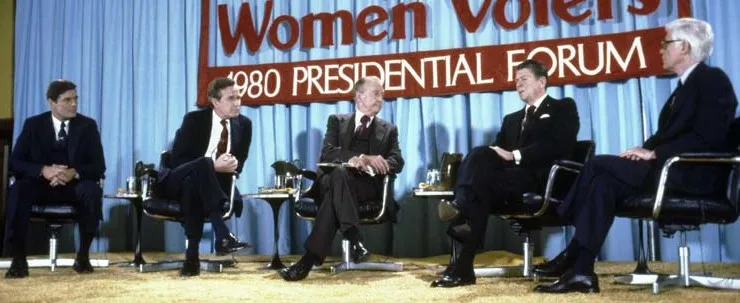
Photo: Ronald Reagan Presidential Library, Public domain, via Wikimedia Commons
Let's be honest for a second. If you've been watching Republican primary races lately — whether it's a congressional seat in Georgia, a governor's race in a swing state, or a Senate run somewhere in the heartland — you've probably had at least one moment where you stopped scrolling and said, out loud, to no one in particular: did they actually just say that?
Yep. They did. And they'll probably say something wilder next week.
But here's what's worth actually unpacking: this isn't random. It's not candidates going rogue or accidentally stepping on a rhetorical landmine. The extreme rhetoric, the conspiracy-adjacent talking points, the culture-war grenades lobbed at every debate stage — it's a strategy. A calculated, data-informed, deeply cynical strategy. And in the context of Republican primaries specifically, it has a track record.
The Incentive Loop Nobody Wants to Talk About
Here's how the cycle works. A candidate says something outrageous — maybe they question the legitimacy of an election, float a conspiracy theory about a political opponent, or make a comment so inflammatory it would've ended a career in 2005. The clip goes viral. Cable news picks it up. Social media explodes. Suddenly, that candidate's name recognition triples overnight, their small-dollar donations spike, and their polling among the GOP base ticks up.
Rinse. Repeat.
The incentive structure of modern Republican primaries essentially rewards outrage over substance. That's not a hot take — it's what the numbers show. When researchers and political analysts look at which moments actually move the needle in primary polling, earned media from controversy consistently outperforms policy rollouts, endorsements, and even ground game operations in certain races.
And the algorithm? Don't even get started. Platforms like X (formerly Twitter), YouTube, and even TikTok are optimized to amplify conflict and emotional reaction. A clip of a candidate calmly explaining their infrastructure plan gets 800 views. A clip of that same candidate calling their opponent a "radical Marxist" at a debate gets 4 million. The math isn't subtle.
The Base Wants the Show
It's also worth understanding who is actually voting in Republican primaries. Turnout in primaries tends to skew toward the most engaged, most ideologically committed slice of the party. That group — the base that shows up in off-year primaries, that donates in small increments, that shares clips in Facebook groups — has been primed over years of conservative media consumption to expect a certain kind of fighter.
Not a policy wonk. Not a coalition builder. A fighter.
Someone who "owns the libs," who refuses to back down, who says the quiet part loud. For a significant portion of the Republican primary electorate, restraint reads as weakness. Nuance reads as complicity. And a candidate who pivots to general-election messaging too early risks getting tagged as a RINO — Republican In Name Only — which, in a primary, is basically a death sentence.
So candidates calibrate. They watch what plays in the room, what gets the standing ovation, what generates the most heat on conservative talk radio the next morning. And they push further.
Case Study: When Unhinged Polling Becomes Unhinged Winning
Look at some of the most notable recent examples. In the 2022 midterm cycles, several candidates who made headlines for promoting election conspiracy theories or making inflammatory statements about immigration, crime, or their political opponents didn't just survive the controversy — they won their primaries comfortably.
In competitive House primaries across states like Arizona, Pennsylvania, and Michigan, candidates who leaned hard into MAGA-aligned rhetoric, even when it generated national backlash, frequently outperformed more moderate opponents who had stronger institutional support and bigger war chests. The viral moment was worth more than the endorsement.
Now, there's a caveat here that matters: general elections are a different story. Several of those same candidates who crushed their primaries went on to lose winnable general election seats because the rhetoric that fired up the base actively alienated independent voters and suburban moderates. The strategy works for primaries. It often backfires in November. But that's a problem for future-candidate to deal with.
The Media Machine That Feeds It
You can't talk about this without talking about the media ecosystem that makes it all possible. Conservative media — from national outlets to regional radio hosts to a sprawling universe of podcasters and YouTube channels — has essentially created a parallel primary within a primary. Candidates aren't just competing for votes; they're competing for airtime on the shows that the base actually watches.
Get on the right podcast, say something spicy enough to get clipped, and you've just bought yourself a week of free advertising to exactly the voters who decide primaries. It's a flywheel, and once it starts spinning, it's hard to stop.
And here's the uncomfortable part for anyone who thinks mainstream media coverage is the antidote: it's not. When major networks cover a candidate's extreme statement to fact-check it or express outrage, they're still amplifying it. The candidate gets the clip, strips the context, and posts it as proof that the "mainstream media" is coming after them. Which, again, plays beautifully with the base.
So Is There a Way Out?
Some Republican strategists will quietly tell you — off the record, obviously — that the race-to-the-bottom dynamic is genuinely bad for the party's long-term electoral math. That you can't keep nominating candidates who are optimized for a primary audience and expect them to win swing states in a general election.
But "long-term electoral math" doesn't pay the bills for a candidate who needs to win this primary, this cycle. The incentives are immediate. The consequences are delayed. And in politics, that's basically a recipe for the behavior to continue indefinitely.
Until either the base shifts, the media ecosystem changes, or a string of general-election losses becomes painful enough to force a reckoning, the outrage auction is open for business. And every two years, the starting bids go a little higher.
Stay tuned. It's going to get weirder before it gets better.