Fourteen Questions and Six Answers: The Downballot Hangover Nobody Saw Coming
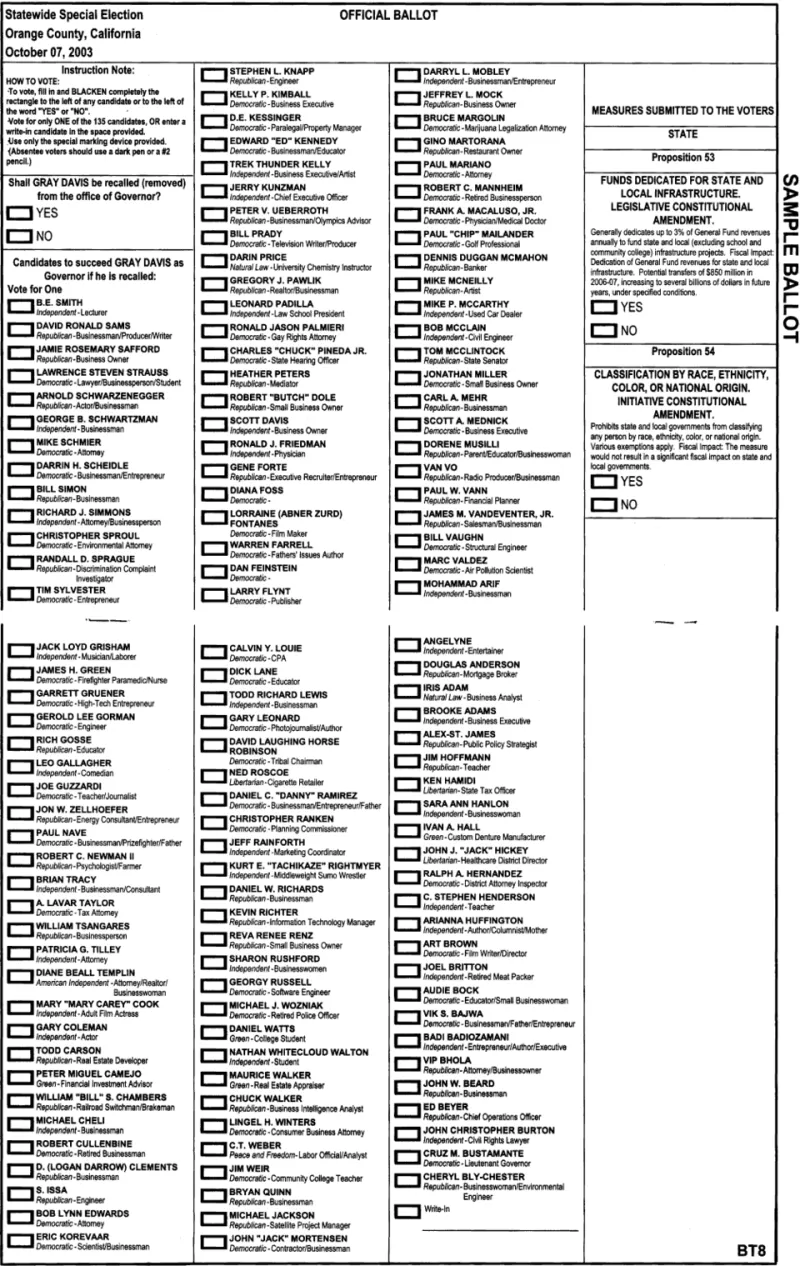
Photo: Government of California, Public domain, via Wikimedia Commons
If you cast a ballot this November 2026 and it felt less like a civic duty and more like a pop quiz you'd forgotten to study for — same. You're in the majority, and the numbers are starting to show it.
The wall of questions
In 2026, dozens of states put serious policy questions directly to voters: cannabis programs, abortion protections, rent stabilization, minimum wage bumps, property tax caps, bond issues for schools, and a handful of local measures so specific they read like someone's HOA got out of hand.
In principle, that's democracy working. In practice, it means you're standing in a booth at 7:40 a.m. before work, reading a 340-word paragraph about millage rates with a font size designed for people with excellent eyesight and no rush.
Most people vote the top of the ballot and then start bailing. That's not a new phenomenon — political scientists have been tracking roll-off for decades — but 2026's ballot length turned it into a story. Early county-level tallies suggest the drop from top-of-ballot races to the final questions was steeper than it's been in a while, especially in states with more than five statewide measures.
The contradictions are the headline
Here's what's genuinely wild. Some of the same electorates that voted for a big progressive ballot question also voted for a big conservative one. Not in different states. In the same state. On the same ballot.
In some places, voters approved legalizing recreational marijuana and then rejected the tax-and-licensing framework that would have actually funded it. Votes for higher minimum wages paired with rejections of the small-business tax credit meant to pay for them. Rent caps advanced in several cities while a statewide version got hammered. Property tax relief was popular everywhere and specific funding mechanisms were popular nowhere.
You can read those results one of two ways. Either voters are incoherent, or voters are acting like people buying à la carte — yes to the thing I like, no to the bill for it. Asking for the policy and rejecting the invoice is a completely rational thing to do in a system that lets you do it. It's also how you end up with unfunded mandates and legislatures cleaning up the mess in 2027.
Issue fatigue is real and it's measurable
There's a version of this where voters are lazy. That's not what happened. What happened is that the total information load on the 2026 ballot exceeded what an average person could reasonably process in the time they had.
Think about the media diet. You get three weeks of aggressive attention on the top races. Then someone hands you a second ballot with 12 questions, each with a yes/no framing that was drafted by whoever got to the ballot first, and each one with dueling ad campaigns full of numbers. That is roughly 12 separate policy debates crammed into a chunk of your Sunday night.
Most people resolve this by voting on one or two questions they've heard the most about and blowing through the rest on gut or vibes or skipping entirely. Which is fine until you realize the questions getting the most airtime aren't the ones with the biggest local impact. Nobody runs a million-dollar ad campaign about a municipal water bond.
Why the ballot got so long
A couple of things stacked up. Direct democracy keeps getting used as a workaround when legislatures are gridlocked, so more contentious stuff gets pushed to the ballot. Ballot committees got better at collecting signatures with paid circulators and text-to-donate infrastructure. And once voters are used to deciding big stuff themselves, there's no incentive for anyone to shrink the list.
There's also a strategic incentive nobody talks about: a long ballot helps incumbents. If you're an incumbent in a competitive race, a crowded ballot means the casual voter is spending attention on Question 4 instead of on your record. Long ballots produce drop-off, and drop-off has an ideological fingerprint depending on who turns out and who quits first.
What this means heading into 2028
Expect reform chatter. Already, a handful of state legislators have floated shortening the ballot, raising signature thresholds, moving measures to primary elections, or requiring a fiscal impact statement on every single one in plain language. Some of those ideas are good. Some are just incumbent protection wearing a cardigan.
But the real issue is simpler: if you're going to put 14 policy decisions in front of people, you owe them a clean, short, readable version of each one. Not a 500-word legal abstract, not two dueling mailers, and not a viral debate over a question most voters never even reached.
2026 was a reminder that direct democracy is a participation sport. And participation drops off fast when the rulebook reads like a mortgage.