Nobody's Watching the Debate: TikTok Clips Are Running the Election Now
Photo: Thomas J. O'Halloran, Public domain, via Wikimedia Commons
Let's be honest with each other for a second. When was the last time you sat down, cleared your schedule, and watched a full political debate start to finish? Not a highlight reel. Not a reaction video. The actual thing — moderators, split-screen podiums, timed responses, all of it?
If you're under 35, the answer is probably never, or close enough to never that it doesn't matter. And yet somehow, you still formed a pretty strong opinion about who won.
That's the whole story right there.
The Debate Format Was Built for a Different Country
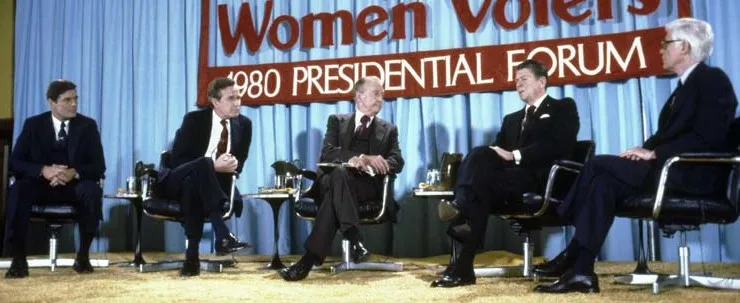
The modern political debate format is basically a relic of the Kennedy-Nixon era — designed for a country with three TV channels, no smartphones, and nothing better to do on a Tuesday night than watch two guys argue about Cuba. It made sense then. You had a captive audience, limited media, and a format that actually felt like must-see television.
Now? The format hasn't changed much, but everything around it has. Networks still hype debate nights like it's the Super Bowl. Campaigns still spend weeks on prep. Candidates still rehearse their zingers in front of mirrors. But the audience that was supposed to be watching has quietly left the building and opened TikTok instead.
Viewership numbers for presidential debates have been declining for years, and even when they spike — like they did during peak Trump-era chaos — the people tuning in are largely older, already-decided voters who treat the whole thing like a sporting event for their team. The persuadable young voter that every campaign is desperately courting? They're getting their information from somewhere completely different.
The 15-Second Clip Is the New Debate Win
Here's how it actually works in 2024 and beyond. A debate happens. Somewhere in that 90-minute slog, one candidate stutters on a number, or gets visibly flustered, or delivers a line that sounds unintentionally hilarious out of context. Within minutes — sometimes while the debate is still live — that clip is cut, captioned, and circulating across TikTok, Instagram Reels, and X. By morning, it has more views than the entire debate broadcast.
The clip doesn't need context. It doesn't need the full exchange. It just needs to hit. A confused look. A bad analogy. A moment where someone clearly didn't know what they were talking about. That's the debate now. That's the part that moves people.
This isn't just a vibe thing, either. Research on political messaging and younger voters consistently shows that short-form video content generates stronger emotional responses and better recall than long-form broadcast media. Your brain is literally wired differently after years of scrolling. A 90-minute debate is asking you to run a marathon when you've been training for sprints your entire life.
Campaigns Know This and They're Adjusting
The smarter political operations have already internalized this shift. They're not trying to win the debate anymore — they're trying to win the clip. Staff are prepped before debates to identify and upload shareable moments in real time. Social teams are on standby with graphics, captions, and reaction content ready to deploy the second something usable happens.
Some campaigns have gone even further, essentially treating TikTok as their primary debate stage altogether. Instead of waiting for a formal debate setting, they're posting direct-to-camera callouts of opponents, response videos to rival ads, and casual "let me explain this policy" content that feels nothing like a debate but functions exactly like one — just faster, cheaper, and with a much bigger audience for their specific demographic.
The tricky part is that this format heavily rewards a certain kind of personality. If you're quick, confident, and naturally charismatic on camera, you can absolutely destroy someone in a TikTok exchange who would have wiped the floor with you in a traditional debate. Policy depth doesn't always translate to a 30-second video. Presence does. Humor does. The ability to make someone feel something immediately does.
So What Actually Happens to Policy?
This is the part that should make everyone a little uncomfortable, regardless of where you land politically.
The debate format — for all its flaws and theatrical nonsense — was at least designed around the idea that candidates should have to explain things. You get a question, you give an answer, someone pushes back. It's messy and often performative, but there's a structure that at least gestures toward substance.
Short-form political content doesn't have that structure. It has incentives, and those incentives push hard toward outrage, mockery, and gotcha moments over anything that resembles actual policy communication. A video of a candidate confidently explaining their healthcare position might get 40,000 views. A video of that same candidate visibly struggling to remember a statistic might get 4 million.
For Gen-Z and millennial voters who genuinely want to understand what candidates stand for, this creates a real problem. The content that's easiest to consume is often the least informative. The most informative stuff requires effort that the algorithm actively punishes.
Some creators and independent political commentators have tried to bridge this gap — taking policy positions and breaking them down in formats that actually work on social media. And honestly? Some of them are doing a better job of political education than the candidates themselves.
The Debate Isn't Dead, But It's Definitely Dying
To be clear — presidential debates aren't going anywhere tomorrow. They're too baked into the political calendar, too useful for TV networks, and too symbolic to just disappear. But their function has fundamentally changed.
They're not persuasion tools anymore. They're clip factories. They're content mines. Every candidate on that stage knows that the moment that matters isn't the answer — it's the three seconds that get screenshotted.
For voters trying to actually make an informed decision, that's a strange and kind of exhausting reality to navigate. You can't just watch the debate and feel informed. You can't just watch the clips and feel informed either. You're left trying to triangulate truth from a media environment that's been optimized for engagement over accuracy.
The debate stage didn't die because young people stopped caring about politics. It died because the format never evolved to meet them where they actually are. And in the meantime, a 19-year-old with good editing skills and a strong opinion is doing more to shape how their generation thinks about candidates than any network anchor ever will.
Make that make sense.