Third Party or Bust: Young Organizers Are Done Trying to Fix the Democrats and Republicans
Photo: Internet Archive Book Images, No restrictions, via Wikimedia Commons
There's a certain kind of conversation that happens at every college political meeting, every community organizing session, every group chat where people actually give a damn about how the country is run. Someone raises an issue — housing costs, climate timelines, student debt, whatever it is that week — and eventually, someone else says the thing that derails everything:
"We should run a candidate."
Not a Democrat. Not a Republican. Their own candidate. Their own party. Their own whole entire thing.
A few years ago, that idea got laughed out of the room. Now? People are actually doing it.
The Patience Has Run Out
The conventional wisdom for decades has been that third parties in America are where political energy goes to die. The electoral system — with its winner-take-all districts, ballot access laws that vary wildly by state, and a duopoly that has spent generations making sure the rules favor itself — is genuinely stacked against anyone trying to build outside the two-party structure.
Most political scientists will tell you the smart play is to work within an existing party, build coalitions, push from the inside. Bernie Sanders spent years doing exactly that, trying to drag the Democratic Party left from within its own machinery. The result was two presidential campaigns, a massive movement, and a party establishment that ultimately absorbed the energy while resisting most of the structural change.
For a lot of young organizers, that outcome was the final lesson they needed. If even Sanders — with his national profile, his fundraising operation, his genuine grassroots army — couldn't fundamentally shift the Democrats, what exactly is the case for trying again?
"I spent three years working inside the party structure," says one 26-year-old organizer from Phoenix who's now building an independent local political organization focused on housing and transit issues. "And I watched good ideas get watered down, good candidates get frozen out, and the same consultants collect the same checks for the same results. At some point you have to ask yourself what you're actually fighting for."
What 'Building Something New' Actually Looks Like
The new wave of youth political organizing doesn't look like what most people picture when they hear "third party." It's not the Libertarians running presidential candidates who get 3% and disappear. It's not the Green Party making the same arguments it made in 2000. It's more fragmented, more local, and in some ways more sophisticated than either of those models.
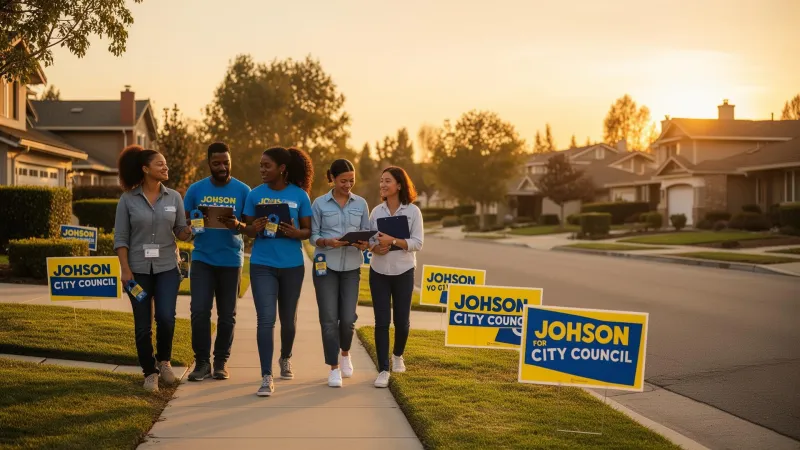
In cities like Chicago, Austin, and Philadelphia, young organizers are building what they call "political homes" — organizations that endorse and fund local candidates, run voter registration drives, and develop policy platforms without formally affiliating with the Democratic or Republican parties. Some of them eventually run candidates under third-party labels. Others operate as independent political action committees. A few are experimenting with ranked-choice voting advocacy as a way to make the entire landscape more hospitable to non-major-party candidates.
The common thread isn't ideology — these groups span a pretty wide range of political priorities. The common thread is a refusal to route their energy through institutions they've concluded are fundamentally unresponsive to them.
"We're not anti-Democrat or anti-Republican in some tribal way," says a 29-year-old co-founder of a Midwest-based political organization that recently helped elect two city council members running as independents. "We're just post-them. Like, we've moved on. We're building infrastructure for what comes next."
The Case Against: Is This Just Organized Losing?
Let's not pretend there isn't a serious counterargument here, because there absolutely is.
The American electoral system is brutal to third parties in a way that isn't true in most democracies. Proportional representation systems in Europe allow smaller parties to win seats, build coalitions, and exercise real power even without winning outright majorities. The US doesn't have that. In most elections, you either get the most votes or you get nothing. That math is genuinely punishing for anyone trying to build outside the two major parties.
Beyond the structural issues, there's the spoiler problem — the very real possibility that a strong third-party or independent candidate pulls votes from whichever major-party candidate is ideologically closest to them, handing the election to someone further away from what the third-party voters actually want. It happened in 2000. There are credible arguments it's happened since. It's not an imaginary concern.
Political scientists who study this stuff aren't uniformly enthusiastic about the micro-party trend. "The energy is real and the frustration is completely understandable," one researcher who studies third-party movements noted in a recent interview. "But building a new party from scratch in the American system is extraordinarily hard, and the history of these efforts isn't encouraging."
For the organizers actually doing the work, this critique lands somewhere between "fair point" and "you're missing what we're actually trying to do."
The Reframe: It's Not About Winning the Presidency
Here's where the conversation gets genuinely interesting. A lot of the young people building these alternative political structures aren't actually trying to win a presidential election. They're not even necessarily trying to win a congressional seat in the near term. They're playing a longer and more local game.
City council seats. School boards. County commissioners. State legislature races where the margins are small and the name recognition is low and an organized, motivated group of a few hundred people can actually swing an outcome. That's where a lot of this energy is being directed — not at the impossible mountain of a federal race, but at the very local decisions that directly affect rent prices, bus routes, school curricula, and zoning laws.
In that context, the "third parties always lose" argument looks a little different. Because at the hyperlocal level, the two-party machine is sometimes barely present. The Democratic and Republican parties often don't have strong infrastructure in local races. An independent candidate with a real community base and a clear platform can be genuinely competitive.
"People always want to talk about the presidential race," says the Phoenix organizer. "But I don't care about the presidential race right now. I care about who's making decisions about my neighborhood. That's where we can actually win."
Innovation or Fragmentation?
The honest answer is probably both, and the outcome depends almost entirely on execution.
If these micro-movements stay siloed, fight with each other over ideological purity, and never figure out how to coordinate beyond their immediate communities, they'll fade out the same way most third-party efforts have. The graveyard of American political history is full of movements that burned bright, generated real excitement, and then collapsed under the weight of their own internal contradictions.
But if some of them figure out how to build durable local infrastructure, develop candidates who can actually win and govern, and connect with each other in ways that create real political leverage — that's something different. That's the kind of slow, unglamorous institution-building that the two major parties did over decades to get where they are now.
The rage-quit generation, as some are calling them, might just be starting that process. Whether the rest of us are patient enough to see where it goes is a whole other question.